Autumn House (Oklahoma City) Emergency Rental Chiller and 45-Week Lead Time Replacement
When Autumn House faced a 45-week lead time for a new chiller, we pivoted to an emergency rental solution and custom piping modifications to keep their residents cool through the Oklahoma summer.
Autumn House (Oklahoma City) Emergency Rental Chiller and 45-Week Lead Time Replacement
Quick Answer
Project Overview
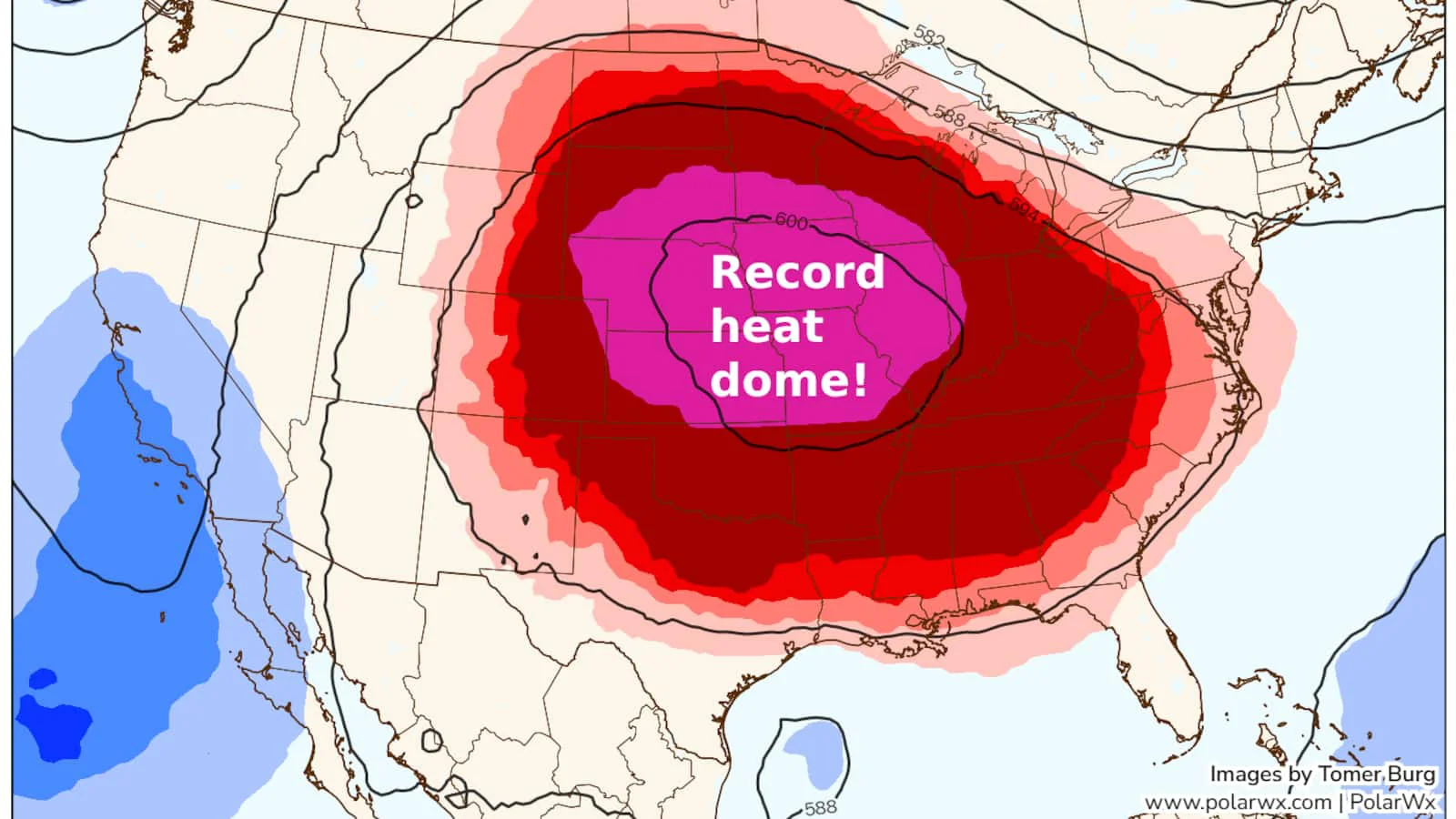
Autumn House, a retirement housing facility in the Oklahoma City area, was experiencing chronic cooling failures. The existing chiller was suffering from repeated compressor failures and fan motor issues. In the high-stakes environment of senior living, “no cooling” isn’t just an inconvenience—it’s a code enforcement risk and a serious health concern for residents during Oklahoma’s “heat dome” months.
Project Challenges: The 45-Week Lead Time Trap
The biggest challenge of this project wasn’t technical—it was logistical. After the facility manager approved the replacement, the supply chain reality of 2024-2025 hit hard: a 45-week lead time for a new Carrier chiller.
The Problem with “Band-Aid” Repairs
Prior to the replacement, we were called out repeatedly for failing compressors. The previous contractor had been “parts swapping” without addressing the aging machine’s overall condition. We encouraged the facility to “pop a new machine down” rather than continuing to dump thousands into a failing unit, but the timing was brutal.
The Pivot to Plan B
With nearly a year-long wait for equipment, we had to pivot immediately to a “Plan B.” We couldn’t leave a retirement home without cooling for an entire summer.
The solution was an emergency rental chiller, but this introduced its own technical hurdle: the building had no “auxiliary” access points to hook up a temporary unit.
This is exactly the deployment scenario covered in our emergency rental chiller guide for Oklahoma facilities.
Solution Design: Creating Auxiliary Access
Most older Oklahoma facilities weren’t built with “chiller rental ports” in mind. To pipe in the rental unit, we had to perform significant modifications to the existing chilled water system.
Custom Piping Modifications
We didn’t have good access to the building’s chilled water pumps or valves. To bridge the gap, we had to:
- Drain the building’s chilled water loop—a multi-day process involving careful chemical treatment of the refill water.
- Remove a section of structural piping in a confined mechanical space with limited overhead clearance.
- Install new high-pressure flanges and auxiliary access valves that could accommodate the rental unit’s connection points.
- Refill and treat the system with specialized corrosion inhibitors appropriate for Oklahoma’s water chemistry.
This “foreseen but difficult” modification allowed us to hook up the short-set rental chiller and maintain 100% cooling capacity for the residents while the new machine was being manufactured. Without this auxiliary loop, the facility would have faced catastrophic indoor temperatures during the July-August heat dome.
For site-wide prep ahead of similar summer conditions, see protecting HVAC during Oklahoma heat domes.
Technical Execution: Chilled Water Loop Integration
Integrating a rental chiller into an existing plant is more than just connecting hoses. It requires balancing the flow rates and ensuring the building’s internal pumps can “talk” to the external chiller’s logic.
- Flow Rate Matching: We had to calculate the GPM (Gallons Per Minute) requirements for Autumn House’s four-story layout to ensure the rental unit provided enough “lift” to cool the top floor.
- Bypass Valving: We installed a temporary bypass so that if the rental chiller tripped, the building’s internal circulation would still maintain some level of movement, preventing stagnant water in the lines.
- Power Configuration: The rental unit required 460V power, which we tapped directly from the main mechanical room distribution panel, ensuring all temporary wiring was up to Oklahoma City electrical code and properly weather-shielded.
Execution Strategy: The New Unit Installation
Once the 45-week wait was over, we coordinated the final installation of the permanent Carrier chiller.
Logistics and Logistics (Voltage Verification)
A common “nightmare” in our trade is ordering a chiller that arrives with the wrong voltage (e.g., ordering 230V when the building is 460V). With a 45-week lead time, a mistake like that is catastrophic. As soon as the unit landed at the crane staging yard, our lead technician performed a physical inspection:
- Voltage Verification: Confirmed 460V building compatibility by checking the motor data plates.
- Tonnage Check: Verified 80-ton capacity matched the engineering drawings.
- Footprint Check: Ensuring the discharge/inlet/outlet locations were exactly as advertised. We measured the flange-to-flange distance to within 1/8th of an inch.
The Precision Crane Set
Because we did the homework on the front end, the new chiller had the exact same footprint as the old one. This allowed us to:
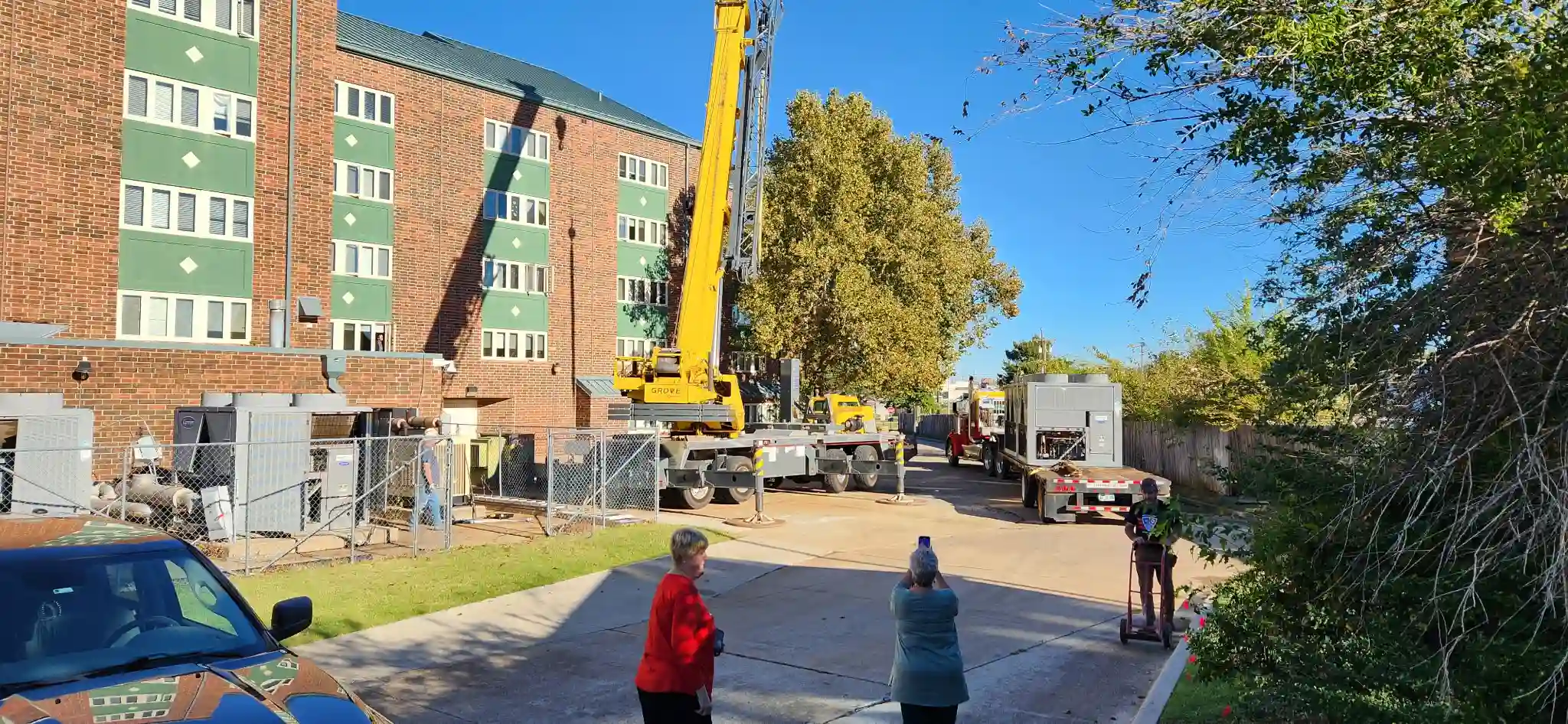
- Use a crane to lift the new unit into place during a 4-hour window on a Tuesday morning.
- “Inch it around” with a pry bar to line up the bolts perfectly.
- Avoid the need for a welder to modify piping on-site during the set. When the crane took 90% of the weight, we used a pry bar to drop the final bolts into place.
Oklahoma Code Compliance: Senior Living Requirements
In Oklahoma, retirement facilities are subject to strict Department of Health regulations regarding indoor air temperature.
Technician Insight: If a facility’s cooling system is down for more than 24 hours during a heat advisory, they may be required to evacuate residents to other locations. This is an expensive, traumatic, and logistically impossible task for many senior living communities.
Our proactive rental strategy didn’t just provide comfort—it provided regulatory compliance. By installing the auxiliary ports, we ensured that even if the new machine has a future failure, a rental can be hooked up in hours rather than days.
Critical Compliance: Factory Authorized Startup
On a high-value asset like a new Carrier chiller, the startup procedure is non-negotiable for warranty protection.
Warning for Facility Managers: Some contractors skip the “Factory Authorized Startup” to save $1,000–$2,000. If you do this, you lose your manufacturer warranty. If a compressor fails in month three, you are on the hook for the entire cost.
We handled the internal checks—voltage rotation, hand draws, and initial startup—but then brought in Carrier for the “official blessing” to ensure the facility’s investment was fully protected by the manufacturer’s warranty. This ensures that if any high-draw issues or compressor faults occur within the first few years, the cost of parts and factory labor is covered.
Lessons Learned
- Supply Chain Defense: If your chiller is over 15 years old, start the replacement conversation now. Don’t wait for a total failure to find out you’re 45 weeks out.
- Rental Preparedness: Adding auxiliary flanges during a scheduled repair is much cheaper than doing it during a midnight emergency. We now recommend all senior living facilities in OKC install these “rental ports” as a standard.
- The Power of Front-End Homework: Measuring the footprint to the inch saved us untold hours in labor and welding costs. A single welder on-site for a day can cost more than the entire planning phase.
If your team is still debating temporary cooling versus immediate replacement, compare both paths with the commercial chiller TCO framework.
Technical Specifications
| Component | Detail |
|---|---|
| New Equipment | Carrier Air-Cooled Chiller |
| Voltage | 460V |
| Communications | BACnet interface with existing BAS |
| Rental Duration | Full Oklahoma Summer Season |
| Modifications | Custom auxiliary chilled water ports |
Your Facility’s Next Upgrade?
Don’t let a 45-week lead time leave your residents in the Oklahoma heat. We specialize in proactive planning and emergency rental solutions for senior living and healthcare facilities. Call (405) 223-9900 or request a proposal.
This case study represents a real-world project performed in Oklahoma City. Equipment specs and timelines reflect conditions at the time of installation.
Related Resources

Oklahoma Ice Storm HVAC Recovery: Freeze Damage Triage, RTU/Chiller Plant Checks, and Safe Restart
A practical Oklahoma guide to recovering HVAC after ice storms: pre-storm prep, freeze damage triage, thaw and restart strategy, and documentation for insurance and risk control.
Protecting Commercial HVAC From Oklahoma Heat Domes: High-Ambient Strategy, Coil Cleaning, and Load Management
A practical Oklahoma guide to surviving heat domes: high-ambient chiller/RTU performance, coil cleaning cadence, tower readiness, demand management, and emergency cooling planning.
Commercial Chiller Tube Cleaning in Oklahoma: Frequency, Methods, and Hard-Water Reality
A field-practical guide to chiller tube cleaning for Oklahoma facilities: how hard water and tower chemistry affect efficiency, how often to clean, and what methods work.
Need Help with Your System?
Our expert team is ready to assist with design, installation, maintenance, and troubleshooting.